

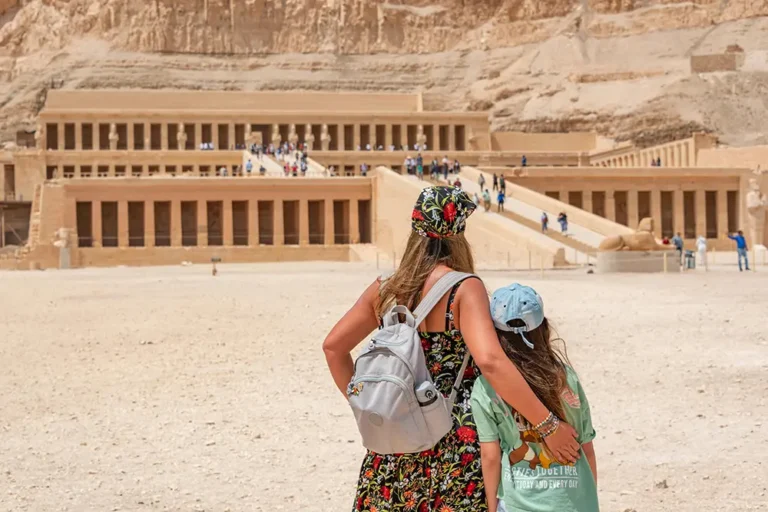

Luxor is set to be one of the world’s most important viewing locations for the total solar eclipse on Monday, 2 August 2027. The combination of totality and the monumental landscape of ancient Thebes makes this a major travel-planning event—but astronomy, eye safety, heat and logistics all need to be handled carefully.
What is confirmed about the 2027 Luxor eclipse?
NASA’s eclipse path data confirms that the 2 August 2027 event is a total solar eclipse and that the path of totality crosses Egypt. NASA gives a maximum totality duration of approximately 6 minutes 23 seconds at the point of greatest duration, not at every location along the path.
For Luxor specifically, Timeanddate’s location calculation currently lists the partial phase beginning at approximately 11:40 local time, totality lasting about 6 minutes 22 seconds around 13:05, and the eclipse ending at approximately 14:26. Astronomical predictions can be refined, and the exact experience depends on the observer’s coordinates, so travelers should recheck official calculations before departure.
Why Luxor requires early planning
A special event compresses demand into a very short date window. Flights, Nile cruises, hotels, licensed viewing areas, private transport and guide availability may not follow normal patterns. Do not assume that an ordinary sightseeing reservation automatically includes access to an eclipse viewing site.
- Confirm the exact viewing location and its access rules.
- Ask whether seating, shade, water, toilets and emergency support are included.
- Separate the viewing-day plan from ordinary temple tickets.
- Allow generous transfer time and avoid unnecessary road movements near totality.
- Get every inclusion, payment deadline and cancellation condition in writing.
Eye safety is not optional
NASA states that ordinary sunglasses are not safe for direct solar viewing. Proper solar viewing glasses or suitable solar filters must be used during the partial phases. Eye protection can be removed only during the brief period when the Sun is completely obscured, and it must go back on as soon as the bright Sun begins to reappear.
Never look at the Sun through a camera, binoculars or telescope unless the device has a correctly fitted solar filter designed for that equipment. If you are uncertain, follow current guidance from NASA and qualified astronomy organizations rather than social-media instructions.
Heat and comfort in August
The eclipse occurs close to midday in August, when Luxor is normally very hot. A credible plan should include shade, drinking water, a controlled waiting area, sun protection, a realistic walking distance and appropriate support for children, older travelers and anyone with a health condition. Seek medical advice where personal heat risk is a concern.
Suggested travel shape
Rather than arriving in Luxor immediately before the event, consider a buffer that allows for transport disruption and orientation. A balanced itinerary could place major West Bank and East Bank sightseeing on separate days, protect 2 August for the viewing program, and add a Nile cruise, Aswan or Red Sea stay before or after the eclipse.
Questions to ask before paying
- What are the exact coordinates of the viewing site?
- Is the site inside the path of totality?
- Who controls access and what happens if access rules change?
- Are certified viewing glasses included, and who supplied them?
- What shade, water, toilets, medical support and transport are provided?
- What is refundable, partially refundable or non-refundable?
- What happens if weather, dust, security restrictions or transport disruption affect the plan?
Authoritative planning links
- NASA: Total Solar Eclipse of 2 August 2027
- NASA: Eclipse safety
- Timeanddate: Luxor eclipse circumstances
Ancient Wonders Tours can use your dates, accommodation grade and required services to shape a travel proposal. A proposal is not confirmation of a protected viewing site until that site and its operating conditions are stated in writing. Start with the tailor-made Egypt tour form.
0 Comment